
Quick Nav
- Five Fairground Systems Under Pressure on One Saturday
- Where Saturday Pressure Built Across the Fairgrounds
- Why the Parking Team Changed the Arrival Flow First
- Moving Signs to Match How Visitors Actually Walked
- Turning Radio Updates Into Clear Fairground Actions
- Keeping Families Comfortable While Lines and Routes Shifted
- What Improved—and What the Fair Should Measure Next Time
- A Copyable Response for the Next Arrival Surge
Five Fairground Systems Under Pressure on One Saturday
Five fairground systems had to work at once during the Saturday morning arrival surge: parking, signage, crowd movement, team communication, and visitor comfort. The peak arrival window ran from about 9:30 AM until just before noon, when small uncertainties could travel quickly from the road to the agricultural attractions.
The useful unit of analysis was one family’s complete trip. A vehicle approached the grounds, entered an active parking row, unloaded passengers, crossed a vehicle route, found the entrance, passed vendor rows, and continued toward the exhibits. Each stage depended on a different volunteer role, yet the family experienced one continuous journey.
That distinction matters. A parking volunteer can clear a vehicle successfully while still placing its passengers beside an unclear walking route. An entrance volunteer can maintain an orderly line while families pause at the back because they cannot see restroom or regrouping information. Local success inside one station may transfer pressure to the next station.
This reconstruction treats the Saturday as an operating case, rather than controlled research. It shows how the Ledyard Fair Association can examine connected decisions under real event conditions and turn practical observations into a repeatable response.
The Working Model
Fairground pressure behaves like a linked system. Vehicle uncertainty creates slower turns. Slower turns extend the approach line. A longer line demands more volunteer attention, while pedestrians still need protected movement between parking areas and the entrance. Clear decisions made early preserve attention for the people already inside the grounds.
Where Saturday Pressure Built Across the Fairgrounds
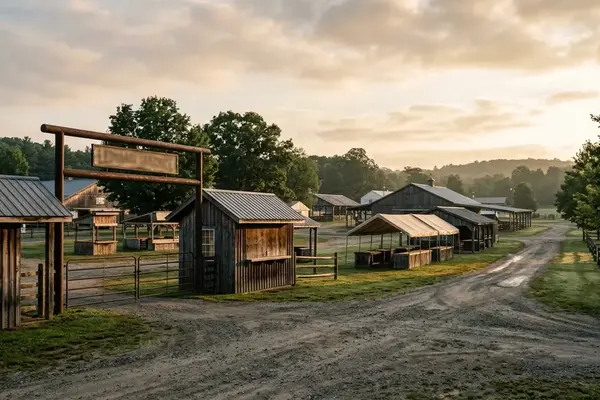
Arriving vehicles needed directions while pedestrians moved among parking areas, entrances, vendor rows, and agricultural attractions. Three distinct pedestrian-flow intersections concentrated those movements. At the main crossing, pedestrian intervals typically occupied 45 to 60 seconds, making coordination between the crossing marshal and parking lead especially important.
A delay at the parking approach rarely stayed there. Vehicles accumulated behind drivers who were unsure which row was active. Families leaving parked cars reached the crossing in clusters. Entrance volunteers then answered more route questions, and guests waiting for relatives gathered near travel paths. Vendor access also became harder to protect when operational attention shifted toward the queue.
Assign the Decision Owners
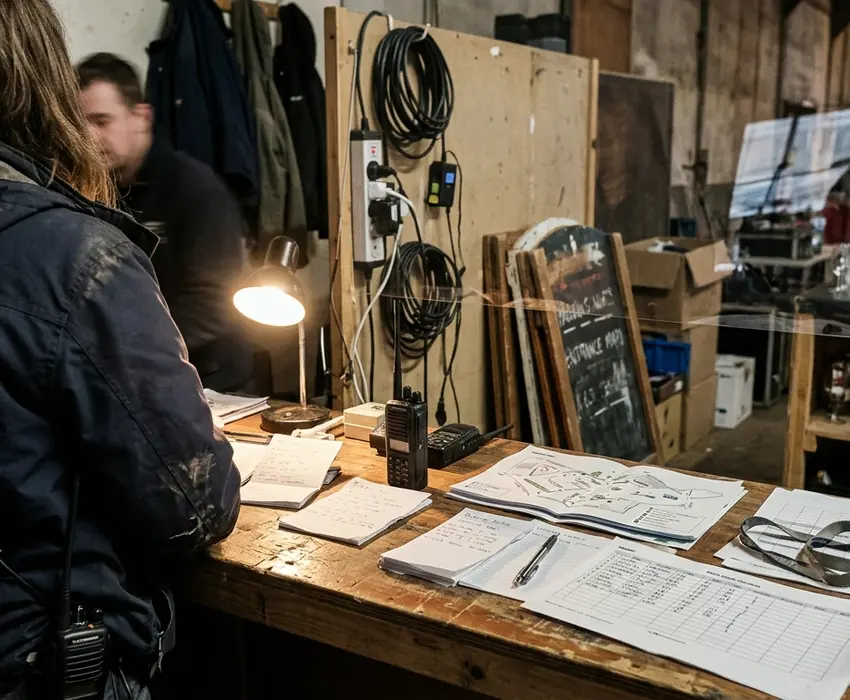
Each pressure point needs a role with a defined decision. The parking lead selects the active row and controls how volunteers direct vehicles. Ahead of the main turn, an approach observer watches conditions. Walkers and vehicles meet under the crossing marshal, who manages that interface. Entrance volunteers maintain admission flow and repeat current route guidance.
- Information point: gives consistent directions for restrooms, water information, seating, regrouping areas, and attractions.
- Vendor coordinator: protects vendor access and reports obstructions near canopies or service routes.
- Roaming fair team member: checks queue edges, narrow passages, and places where families pause.
- Designated coordinator: acknowledges radio requests and identifies who owns the next action.
A central observation point near the main gate gave the crossing marshal and parking lead a shared operating picture. Complaints still mattered, but conditions at a defined location gave the team a firmer basis for changing flow.
Main-Gate Principle
When several roles can see the same junction, the team can coordinate intervals and route changes instead of treating each symptom as a separate problem.
Why the Parking Team Changed the Arrival Flow First
Vehicles were arriving while walkers, parked cars, and volunteers competed for attention at the key approach points. Drivers had only a short period to identify the active parking route, interpret a hand signal, check for pedestrians, and commit to a turn.
The parking response therefore started upstream. The team placed the primary decision cone on the order of 150 feet before the main turn and assigned one designated approach observer. This position gave drivers time to understand where they were going before steering into the conflict area.
Sequence the Arrival Decision
- Observe the approach. One person watches where hesitation begins, whether the preselected cone marker has been reached, and whether pedestrian movement is affecting vehicle progress.
- Confirm the active row. The parking lead names the row currently receiving vehicles so every directional volunteer gives the same instruction.
- Place direction before commitment. A volunteer stands upstream of the turn, where a driver can still select the correct path without stopping at the apex.
- Protect the crossing view. Volunteers, signs, and waiting groups stay clear of the sightline between drivers and the pedestrian crossing.
- Preserve operational access. The parking plan leaves a clear route for fair operations rather than consuming every open lane with arriving traffic.
The team considered placing another volunteer directly at the turn apex. That position added another person to an already crowded visual field, so the upstream placement carried the primary instruction instead. The volunteer at the decision point could establish driver intent earlier, while the crossing marshal retained a clear working area.
The general lesson is simple: uncertainty should be removed before a driver reaches the physical decision. Corrections made after a vehicle commits require more gestures, more stopping, and more attention from everyone nearby.
Moving Signs to Match How Visitors Actually Walked
A sign can be present and still arrive too late in the visitor’s decision process. Useful wayfinding appears before a fork, crossing, entrance, or change in route. It also remains visible from the height and angle at which the visitor approaches.
Volunteers walked the relevant paths from two practical viewpoints: the eye level of a seated driver and the lower line of sight of a child moving with a family. That check exposed obstructions that looked harmless from the sign’s installation position. Open vendor canopies interrupted longer sightlines. Parked trucks covered ground-level messages. Groups waiting near entrances formed temporary walls, while bags and strollers narrowed what adults and children could see.
Use the Approach View
Upstream signs were turned to roughly a 45-degree angle so their message faced approaching traffic rather than the edge of the road. Walking routes kept at least three feet of clearance, which stopped sign placement and other equipment from eating into the usable path.
The review followed a practical order:
- Stand where the visitor first needs the information.
- Look toward the sign from the actual direction of travel.
- Check the view behind parked vehicles, open canopies, and waiting groups.
- Move or turn the sign while protecting the walking clearance.
- Walk the route again with attention divided between the sign, nearby people, and the next destination.
The final check is important because fair visitors rarely study wayfinding in isolation. They guide children, carry purchases, watch animals, talk with relatives, and scan for entertainment. A message that works only under full attention will underperform during a busy Saturday.
Fork Before Sign
If a family has already stopped at the fork, the directional message belongs farther upstream.
Turning Radio Updates Into Clear Fairground Actions
“Parking is busy” describes a general state. It gives another volunteer no location, no condition to verify, and no requested action. Several people may answer, or everyone may assume somebody else has taken ownership.
The fair team used a compact four-part radio message structure: caller’s role, exact location, observed condition, and requested action. One designated coordination role acknowledged requests and identified the responder. Volunteers could still report urgent conditions immediately; the coordination role reduced duplicate instructions after the report entered the channel.
Build an Actionable Call
- Role: “Approach observer.”
- Location: “At the primary decision cone before the main turn.”
- Condition: “The vehicle line has reached the cone while families are entering the crossing.”
- Requested action: “Confirm the active row and send one directional volunteer upstream.”
The coordinator then closes the ownership gap: “Parking lead owns the response; entrance and information teams, hold for the route update.” This acknowledgment tells the caller that the report was heard and tells other volunteers who will act.
Radio discipline also improves the quality of later review. A timestamped request with an exact location can be compared with the acknowledgment and subsequent condition. Open-ended chatter leaves little evidence about what changed or when the team responded.
Channel Discipline
Messages should remain short enough for urgent traffic to enter the channel. Exact nouns help: name the cone, row, gate, crossing, vendor row, or attraction junction. “Over there” and “near parking” force the listener to ask another question.
Keeping Families Comfortable While Lines and Routes Shifted
Visitor comfort functions as part of crowd management. A tired family may stop at the edge of a queue to decide where to rest. Parents who cannot find restroom directions often leave an orderly line to ask several volunteers. And when a stroller gets blocked in a narrow passage, the group behind it spills into another route.
Roaming team members worked 15-to-20 minute rotation cycles around shifting queue perimeters. Their task was to find the point where uncertainty became physical obstruction: a family pausing in a travel path, a bench hidden from the approach, or a directional sign covered by the queue itself.
Check Comfort Along the Route
- Seating visibility: Can guests see a nearby place to sit before they stop in the path to search?
- Rest areas: Are the routes to quieter spaces clear and easy to explain?
- Drinking-water information: Do entrance and information volunteers give the same direction?
- Restroom directions: Is the next turn visible from the point where a guest asks?
- Stroller movement: Does the usable route retain its 36-inch minimum clearance?
- Family regrouping: Are guests directed toward either of the two designated regrouping areas away from narrow passages?
Route changes must reach information volunteers at the same time as parking and entrance teams. Otherwise, an operational adjustment creates a second version of the fairgrounds in conversation: one route in the field and an older route still being described to visitors.
Cy Anderson Fellowship Hall and other recognizable fairground destinations can serve as orientation references when they genuinely clarify the route. The instruction still needs the next turn or crossing. A landmark alone may identify the general direction without resolving the immediate decision.
What Improved—and What the Fair Should Measure Next Time
The defensible changes were qualitative. Directions became more consistent, driver decisions moved farther upstream, radio requests carried actionable details, and comfort checks became part of crowd movement rather than a separate hospitality task.
The next step is a scorecard collected at defined locations. End-of-day recollection tends to merge several periods together. Timestamped checks preserve the sequence between an observed condition, an adjustment, and the next observation.
Fairground Operational Scorecard
- Time from vehicle arrival to parking: The approach observer timestamps arrival and parking during a 10-minute observation window.
- Maximum vehicles waiting at the marker: One observer conducts a visual count at the preselected cone during the same 10-minute window.
- Direction questions: An entrance or information volunteer tallies questions during a fixed observation window at one named station.
- Radio response time: The coordinator records the timestamp of the request and its acknowledgment.
- Pedestrian hesitation: One observer watches one defined junction and records repeated pauses before and after a sign or route adjustment.
- Access obstructions: A roaming team member notes the exact location, obstruction type, and time reported.
Each comparison needs the same observer position, defined location, and observation duration before and after the adjustment. Changing the junction or measurement window weakens the comparison because the team may be observing a different operating condition.
One catch applies to this scorecard: the queue markers and timing thresholds described here belong to dry-weather operations. Muddy fields change vehicle spacing and pedestrian speed enough to require a separate field plan.
Measure the Decision Point
The strongest scorecard watches the place where a visitor must act. For parking, that means the upstream marker and main turn. On walking routes, it is the named junction where hesitation occurs. Radio traffic points to the interval between a specific request and its acknowledgment.
A Copyable Response for the Next Arrival Surge
Consider a community fair using the same trigger: the vehicle line reaches a preselected cone on the order of 150 feet upstream of the main turn while families are crossing toward the entrance. The active parking row remains open, but arriving drivers need earlier direction. The following seven-step response gives every role a concrete next move.
- Report the trigger. The approach observer radios: “Approach observer at the primary cone. Vehicle line has reached the marker while families are entering the main crossing. Request active-row confirmation and one volunteer upstream.”
- Confirm the route. The parking lead identifies the active row and sends one directional volunteer to the decision point before the turn.
- Protect the crossing. The crossing marshal keeps the pedestrian area visible and reports whether the current 45-to-60 second intervals are affecting vehicle movement.
- Assign ownership. The designated coordinator acknowledges the request, names the parking lead as response owner, and tells entrance and information volunteers that an updated route instruction is coming.
- Update visitor guidance. Entrance and information teams repeat the same parking-exit, restroom, water, and regrouping directions. Roaming team members check whether families are stopping along the changed route.
- Clear the path. The vendor coordinator and roaming team inspect canopies, parked vehicles, waiting groups, and signs near the approach. They maintain the 36-inch walking clearance and turn upstream signs toward the arriving line when needed.
- Recheck after the adjustment. The approach observer runs a 10-minute observation window at the same cone, records vehicle waiting and arrival-to-parking timestamps, and reports the condition through the four-part radio structure.
Ten minutes later, the observer stands at the same marker, completes the same checks, and radios the next exact condition, location, and requested action.






Comments
No comments.
Write a Comment