
Quick Nav
- Plan Around the Four Needs That Shape a Fair Day
- Confirm the Details That Could Change Your Visit
- Make the Parking-to-Entrance Stretch Manageable
- Choose Routes by Surface, Distance, and Energy Cost
- Schedule Rest Before Anyone Reaches Their Limit
- Prepare for Sun, Rain, Heat, and Cooler Evenings
- Pack for Comfort Without Creating More Work
- Build a Simple Visit Plan
Plan Around the Four Needs That Shape a Fair Day
“Four needs can shape every hour at the fairgrounds: mobility support, sensory relief, stroller access, and limited-stamina pacing.”
Comfort depends on the full sequence of arrival, movement, recovery, and departure rather than a single accommodation at the main gate. A family might secure premier parking but struggle if they lack a plan for sensory breaks later in the afternoon. Looking at the entire timeline helps guests, caregivers, and families make informed decisions about their stamina and equipment requirements.
This framework works as a decision tool. It helps visitors identify which environmental factors will affect their specific group. Recognizing these four distinct categories lets you prioritize the logistics that matter most to your family.
Confirm the Details That Could Change Your Visit
A successful outing begins with a strict pre-arrival checklist. You must separate absolute must-have conditions from flexible preferences. A manageable parking-to-gate distance or room to deploy a mobility device ramp are hard constraints. A specific food vendor or a preferred seating area are secondary preferences.
Verify your hard constraints roughly a day or two before departure. Check the current fair schedule, operating hours, and parking instructions directly with the organizers. If a specific route or parking arrangement will determine whether attendance is possible, contact the fair team before traveling.
Ledyard Fairgrounds Navigation Advisory
Relying on cached or printed maps from previous seasons can lead to dead ends, as vendor layouts and temporary fencing shift annually. Always request the most current grounds map upon arrival or download the latest version on the morning of your visit.
Make the Parking-to-Entrance Stretch Manageable
The physical transition from your vehicle to the admission gate often sets the physical baseline for the entire day. Arrive with enough time to assess the route without rushing. Follow the current parking directions closely and communicate your unloading needs to the attendants immediately upon entering the lot.
Drop-off zone dwell times are typically limited to a few minutes for active unloading. Keep mobility aids, walkers, or strollers highly accessible in your vehicle rather than buried under coolers and backpacks. Before fully unloading passengers, evaluate the immediate area from the vehicle. Look at the distance to the gate, the slope of the terrain, surface firmness, and any visible curb or threshold transitions. You must also determine whether everyone in your group can safely repeat this exact trip in reverse during departure.
Choose Routes by Surface, Distance, and Energy Cost
We initially considered mapping out specific accessible routes across the property, but rejected this approach because weather conditions rapidly alter unpaved surfaces. Instead, the focus shifted to teaching visitors how to evaluate the ground in real time.
The shortest visible path across the fairgrounds may not be the easiest route for a wheelchair, walker, stroller, cane user, or guest conserving stamina. Judge a route by the presence of packed earth, grass, gravel, mud, slopes, bottlenecks, and thresholds. Watch for threshold lips of more than half an inch at the entrances to exhibition tents or temporary structures. You will also encounter varying soil compaction across the fairgrounds depending on recent rainfall and foot traffic patterns.
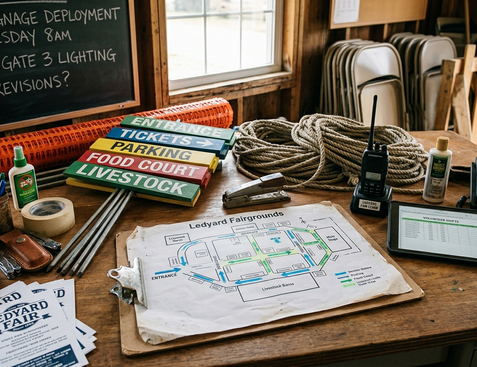
Group your nearby priorities to conserve energy. Visit the agricultural exhibits, then the nearby craft tents, rather than repeatedly crossing the grounds. Choose one or two essential attractions before adding optional stops to your itinerary.
Schedule Rest Before Anyone Reaches Their Limit
Proactive pacing prevents exhaustion. Take a break while the group still feels well rather than waiting for distress or frustration to dictate your schedule. Groups managing sensory sensitivities often benefit from roughly matching each activity with an equal stretch of recovery time.
Identify possible lower-intensity locations by observing crowd flow, speaker volume, ride noise, animal sounds, odors, flashing lights, shade, and seating availability. Areas near the Cy Anderson Fellowship Hall sometimes offer a slower pace, though conditions fluctuate based on the daily schedule. Do not expect a designated quiet zone or guaranteed seating. Always confirm current amenities upon arrival or choose a personal fallback, such as returning to your vehicle for a quiet break when re-entry is permitted.
Prepare for Sun, Rain, Heat, and Cooler Evenings
Weather preparation directly affects accessibility. High heat can drastically shorten comfortable visit times, while rain immediately changes the navigability of walking surfaces. Evening temperatures also affect guests who remain still for long periods in mobility devices or strollers.
Check the current local forecast shortly before departure rather than relying on an earlier weekly outlook. Records from the Ledyard Fair Association indicate that temperature drops of roughly 10 to 15 degrees during evening hours mean stationary guests will want secondary clothing layers.
Association of Connecticut Fairs Comfort Tip
Pack practical supplies tailored to the forecast. Bring adequate water, sun protection, a lightweight rain layer, dry socks, and a lap covering. Use sealed bags to protect essential medication or electronic communication devices from dust and sudden moisture.
Pack for Comfort Without Creating More Work
A heavy bag increases pushing, carrying, and unloading effort, which drains stamina before you even reach the exhibits. Build a prioritized packing list that distinguishes essential equipment from heavy just-in-case items.
Your essential tier includes admission or payment items, a phone with backup power, water, weather layers, ear protection, personal care supplies, mobility-device essentials, stroller supplies, and a written emergency contact. Leave non-essential bulk in the vehicle.
Mobility Equipment Pre-Departure Takeaway
Perform pre-departure equipment checks before leaving your driveway. Verify tire pressure, test brake engagement on mobility devices, inspect stroller harnesses, and confirm that all folding mechanisms operate smoothly.
Build a Simple Visit Plan
A successful fair experience normalizes early departure. Frame your visit around safe participation and comfort rather than the completion of a full grounds circuit. Discuss your priorities as a group and agree that leaving while everyone is still in good spirits is the primary goal.
Following guidelines from the Association of CT Fairs, families should establish clear communication signals for when a member needs to leave a high-stimulus zone. The three checkpoints that hold a day together are a verified entry location, identified recovery zones, and a predetermined departure strategy — lock those down and the rest of the visit bends to fit your group, not the other way around.












Comments
No comments.
Write a Comment