
Start With the Parade Purpose, Scale, and Decision Team
A community light parade operates as part celebration, part traffic plan, and part volunteer operation—a complex mix that requires early coordination. Before booking a single float, organizers must define the event goal. Is this a holiday celebration, a town tradition, an agricultural fair-season attraction, a fundraiser, a sponsor showcase, or a community appreciation night? The answer dictates the scale.
Forming the core decision team about 14 to 16 weeks prior to the target event date provides enough runway to handle logistics. This planning group should include a parade chair, route lead, participant coordinator, volunteer lead, safety liaison, communications lead, and cleanup lead. Early on, the committee established the event scale by mapping available volunteer bandwidth against municipal requirements. They rejected a sprawling, multi-town route in favor of a concentrated, easily managed path.
Choose a Route That Works After Dark
A parade route that works perfectly in daylight may become hazardous once visibility drops, temperatures fall, and spectators cluster near intersections. Organizers finalized the path by physically walking the proposed streets under the exact conditions of the event. Conducting the route walk-through between 7:00 PM and 9:00 PM helps identify dark spots, low-hanging branches, and uneven shoulders that are easily missed during the day.
Ideal route qualities include simple turns, a wide staging area, a safe dispersal zone, available parking, lighting at key crossings, clear emergency access, and room for spectators to stand back from moving vehicles. Rural or fairground-adjacent settings require special attention. Unlit roads, uneven shoulders, livestock trailers, tractors, hay wagons, and families walking from parking fields all introduce unique risks.
Quick Tip: Ensuring a minimum 24-foot road width in the staging area allows for a dual-lane lineup and an emergency bypass.
Handle Permits, Traffic Control, and Emergency Access Early
Organizers should contact municipal officials, police, fire, public works, and any road authority before promoting a route. Submitting permit applications and traffic control plans 60 to 90 days in advance prevents last-minute cancellations.
Likely planning needs include street closure approval, traffic detours, barricades, no-parking areas, emergency lanes, insurance documentation, and fire marshal review for generators or fuel. The safety liaison coordinated with local public works and law enforcement to determine where physical barricades were strictly necessary versus where rolling blocks would suffice, prioritizing continuous traffic flow on adjacent arteries.
Maintaining a continuous, unobstructed 12-foot emergency access lane alongside the parade route is critical. When designing temporary traffic control, planners should consult the Federal Highway Administration’s Manual on Uniform Traffic Control Devices as a primary source for traffic-control principles.
Set Float, Vehicle, and Lighting Standards Participants Can Follow
Provide a practical participant standard sheet rather than vague encouragement to decorate. The participant coordinator drafted the vehicle rules by reviewing incident reports from past regional events. They mandated secured battery-powered lighting over portable gas generators to reduce fire risks and noise.
Lighting guidelines must cover battery-powered lights, properly secured cords, no loose strands dragging near tires, weather-aware power choices, and backup batteries. Adjusting generator and lighting rules based on whether the floats are primarily flatbed trucks or highly flammable dry hay wagons prevents catastrophic accidents.
Vehicle and float standards require driver visibility, working brakes, safe rider positions, handrails or seated positions, and no jumping on or off moving units. Mandating a strict 30 to 40-foot spacing interval between moving units keeps the procession safe. Requiring at least 2 walking spotters for articulated vehicles like tractor-trailers or hitched wagons ensures drivers have eyes on their blind spots.
Build a Volunteer Plan for Staging, Crowd Flow, and Communications
Volunteers need assigned posts, not just enthusiasm. Break roles into staging check-in, lineup marshals, route monitors, spectator greeters, parking helpers, accessibility assistance, lost-and-found contact, cleanup crew, and a radio or phone communications lead.
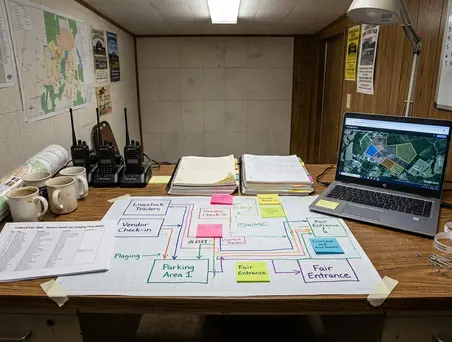
Firsthand testing suggests assigning 1 route monitor per 150 feet of spectator-heavy zones provides adequate crowd oversight. The volunteer lead built the communication tree by mapping out a strict hierarchy of radio calls. This ensures that a vehicle breakdown in the middle of the route is reported directly to the staging manager rather than causing radio chaos. Using UHF radios on a dedicated frequency rather than relying on cellular networks bypasses the lag frequently experienced during large crowd gatherings.
Staging-area flow requires one entrance, a check-in point, lineup lanes, pedestrian-free vehicle lanes where possible, and a clear exit for units that need to leave early.
Make the Event Welcoming for Families, Exhibitors, and Neighbors
Frame hospitality as an operational issue—not a decorative extra. Distributing neighborhood notification flyers 10 to 14 days before the event manages local expectations and reduces complaints.
Family needs dictate arrival guidance, restrooms, stroller-friendly viewing areas where feasible, warming options, a clear start time, and simple directions back to parking. Setting up portable restrooms at a ratio of 1 unit per 250 expected attendees in the staging and dispersal zones prevents long lines in the cold.
The logistics team selected accessible viewing zones by cross-referencing street lighting maps with known curb cuts and proximity to paved parking lots. This ensures wheelchairs and strollers won't have to navigate dark, uneven grass. Planners must also provide reserved or suggested accessible viewing areas, nearby drop-off if allowed, quieter viewing zones for noise-sensitive guests, and advance notice of sirens or bright flashing lights.
Day-Of Run Sheet: From Lineup to Final Sweep
The parade chair constructed the day-of timeline by working backward from the official step-off time, calculating the exact minutes needed to check in, inspect, and stage each category of vehicle. Staggering participant arrivals in 15-minute blocks starting 120 minutes before step-off prevents a massive traffic jam at the staging entrance.
A day-of timeline includes the setup window, volunteer briefing, participant arrival, safety check, route closure, parade step-off, final unit release, road reopening, cleanup, and debrief. The run sheet must list contact names, decision points, lineup order, emergency contacts, map notes, weather triggers, and post-event cleanup assignments.
Note: A rigid run sheet falls apart if the staging area lacks a dedicated bypass lane for late arrivals or broken-down vehicles. We have seen a parade stall completely because a single tractor broke down in a staging area with no bypass lane, forcing the entire lineup to halt.
Practical day-of checks involve confirming barricades, testing radios or phones, inspecting lighting on floats, reviewing spacing, confirming the first-aid location, and verifying that the final sweep vehicle or crew knows its role. Scheduling the final route safety sweep about 30 minutes prior to forward movement clears the path of last-minute obstacles.
What This Guide Cannot Decide for You
The authors defined the guide's boundaries by separating community-level logistical advice from statutory requirements. Local ordinances and official traffic-control manuals supersede general best practices.
This guide is a planning framework, not legal, insurance, engineering, fire-code, or law-enforcement advice. While the spacing and staging intervals provided here reflect successful implementations at the Ledyard Fair and similar agricultural events, high-density urban environments with tighter turning radii will require custom engineering assessments.
Summary: Organizers must confirm requirements with local officials, venue owners, insurers, emergency services, and road authorities before announcing final details.






Comments
No comments.
Write a Comment